When evaluating rotating mechanical systems—such as electric vehicle (EV) traction drive motors, internal combustion crankshafts, industrial conveyor gearboxes, and wind turbine generators—mechanical engineers must frequently translate shaft twisting force (Torque) and rotational velocity (RPM) into total accumulated mechanical energy (Joules or kilowatt-hours).
Work (Joules) = Torque (N·m) × Angular Displacement (radians)While linear work calculations (W = F · d) are straightforward, rotating machinery introduces continuous circular motion where distance accumulates along a circumference as angular displacement θ.
In this comprehensive engineering manual, we derive the fundamental rotational work equations from first principles, demonstrate how to integrate rotational speed (RPM) over operating duration, link torque to electrical and mechanical power, and work through real-world case studies from automotive dynamometer testing to industrial manufacturing.
1. Fundamental Derivation: From Linear Force to Rotational Work
To understand why rotational work equals torque multiplied by radians, let us trace the physical mechanics of a rotating cylindrical shaft from first principles:
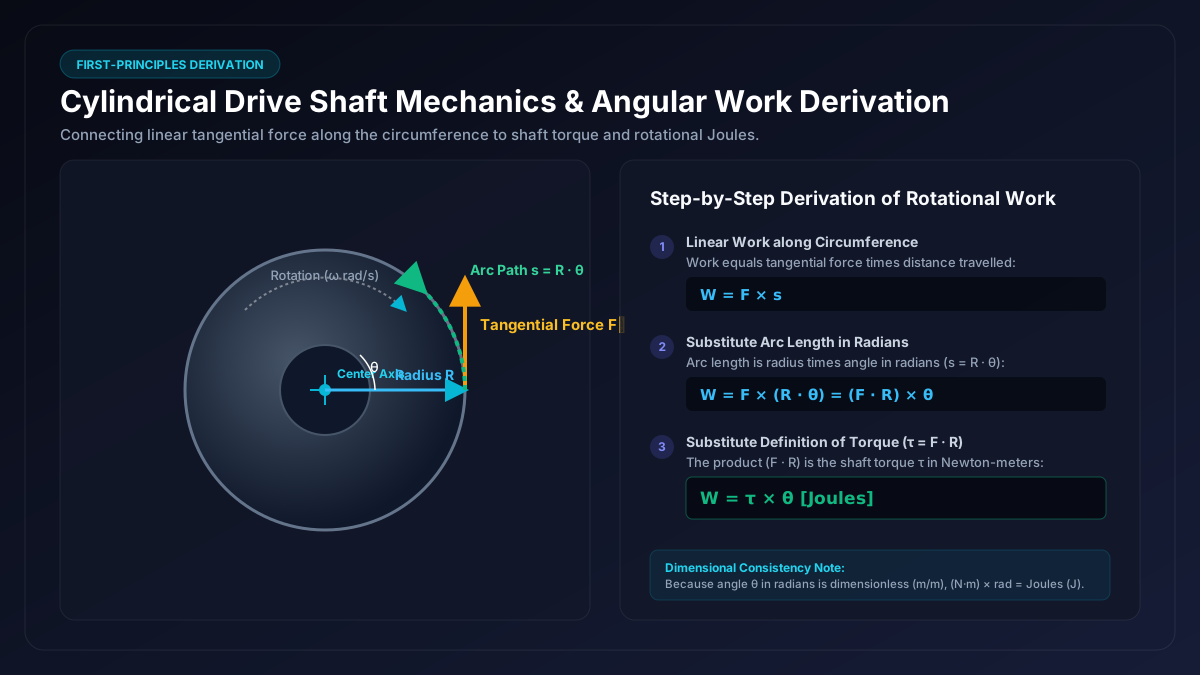
Step 1: Linear Work Along the Shaft Circumference
Consider a solid cylindrical drive shaft of radius R. A tangential force F is applied perpendicularly to the outer perimeter, causing the shaft to rotate.
As the shaft turns, the point of force application travels along the circular arc of circumference s. According to the foundational definition of mechanical work:
W = F × sWhere:
- W is work in Joules (J)
- F is tangential force in Newtons (N)
- s is the circumferential distance traversed in meters (m)
Step 2: Expressing Arc Length in Terms of Angular Displacement
In plane geometry, the relationship between arc length s, radius R, and angular sweep θ (measured in radians) is:
s = R × θSubstituting this geometric relationship into the work equation gives:
W = F × (R × θ) = (F × R) × θStep 3: Recognizing the Definition of Torque
The product of tangential force F and moment arm radius R is the definition of shaft torque (τ):
τ = F × RSubstituting torque τ into our work equation yields the master formula for rotational mechanical work:
W = τ × θWhere:
- W is the mechanical work performed in Joules (J)
- τ is the shaft torque in Newton-meters (N·m)
- θ is the cumulative angular displacement in radians (rad)
The radian is a dimensionless SI ratio: rad = arc length / radius = m / m = 1. When multiplying torque (1 N·m) by an angle in radians, the unit evaluates to (N·m) × 1 = N·m = 1 Joule.
2. Converting RPM and Operating Time to Total Joules
In real-world machinery, shaft velocity is almost universally monitored in revolutions per minute (RPM) rather than radians per second.
To calculate total work over an operating interval t (in seconds), we must convert RPM and duration into total radians:
Step 1: Revolutions to Radians
One complete revolution equals 360 degrees, which corresponds to 2π radians (≈ 6.283185 rad):
θ = Revolutions × 2πStep 2: Determining Total Revolutions from RPM and Time
If a motor runs at a constant speed of RPM for a duration of t seconds:
Rotational Frequency (rev/s) = RPM / 60
Total Revolutions (N) = (RPM / 60) × t
Step 3: The Complete Rotational Work Equation
Substituting total revolutions into our work formula:
θ = 2π × (RPM / 60) × t
W = τ × 2π × (RPM / 60) × t
Rearranging into standard engineering notation:
W (Joules) = (2π / 60) × τ (N·m) × RPM × t (seconds)Since 2π / 60 = π / 30 ≈ 0.104719755:
W (J) ≈ 0.10472 × τ (N·m) × RPM × t (s)Use our free Rotational Work Calculator to compute these values with live metric and imperial unit switching.
3. The Power Connection: From Torque & RPM to Watts and Kilowatts
Mechanical work represents the cumulative energy transferred over an interval of time, whereas Power represents the instantaneous rate at which that work is delivered:
P = dW / dtDifferentiating our rotational work formula with respect to time t yields the mechanical power equation:
P = τ × ωWhere ω is the angular velocity in radians per second:
ω = (2π × RPM) / 60Power in Watts and Kilowatts
Substituting ω into the power expression:
P (Watts) = τ (N·m) × (2π × RPM) / 60To express mechanical output power directly in Kilowatts (kW):
P (kW) = (τ (N·m) × RPM) / 9,548.8Converting Power Directly to Cumulative Energy
Once you know the mechanical power in Kilowatts:
Work (Joules) = P (Watts) × t (seconds)
Work (Kilowatt-hours, kWh) = (P (kW) × t (hours)) = Joules / 3,600,000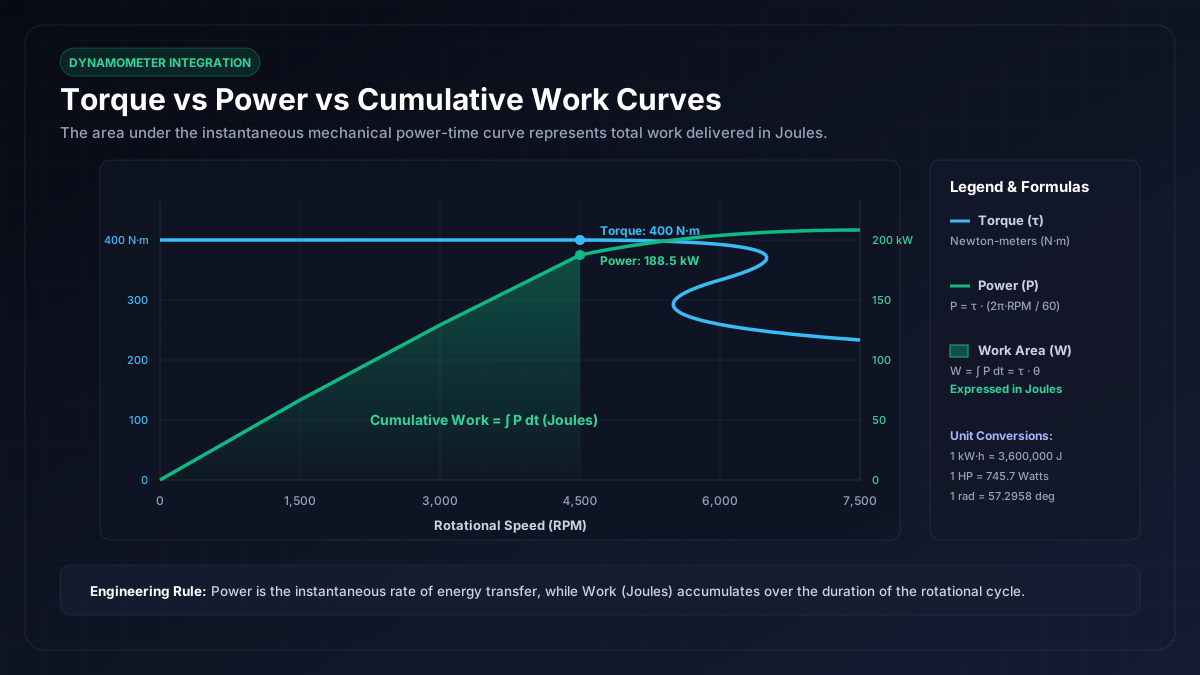
Calculate shaft power and convert directly to mechanical horsepower using our precision Torque to Power Calculator.
4. Industrial Case Studies with Worked Step-by-Step Math
To show how these equations function in field engineering, let us examine three detailed case studies from automotive, energy, and precision manufacturing.
Case Study 1: High-Performance Electric Vehicle (EV) Acceleration Burst
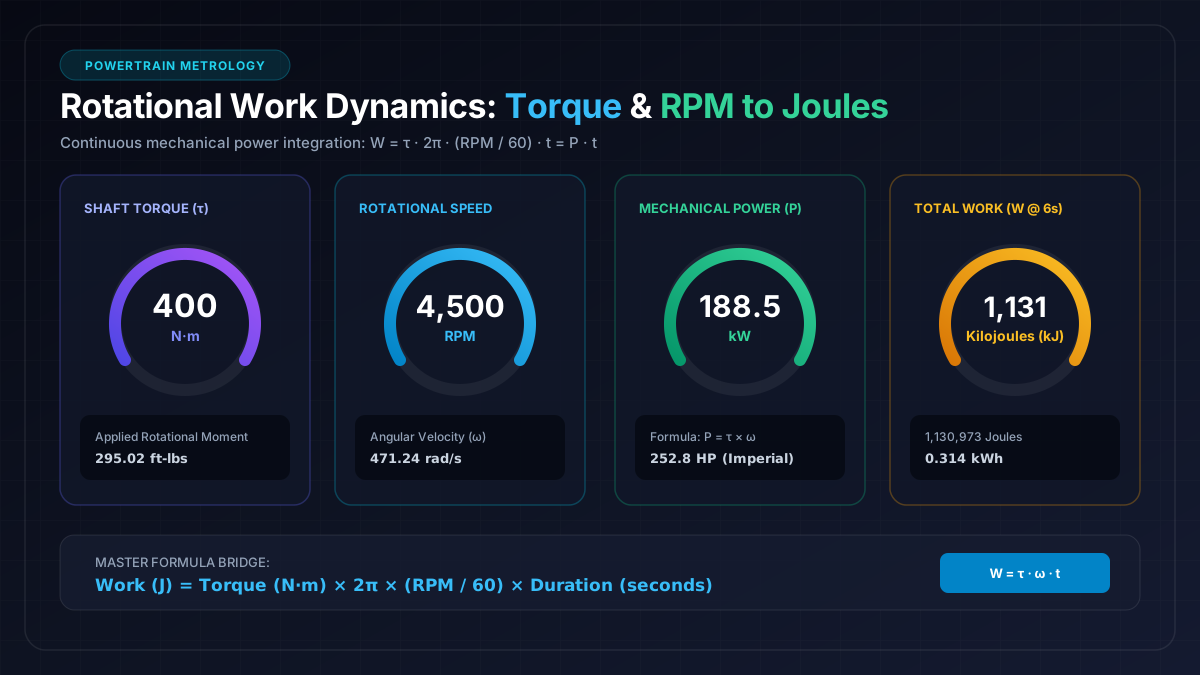
An electric vehicle motor delivers a sustained average torque of 400 N·m while spinning at 4,500 RPM during a high-speed acceleration pass lasting 6.0 seconds.
Objective:
Calculate:
- Shaft angular velocity ω
- Instantaneous mechanical power output in kW and HP
- Total cumulative mechanical work delivered to the driveline in Joules and kWh
Calculation:
-
Angular Velocity (ω):
ω = (2π × 4,500) / 60 = 150π ≈ 471.239 rad/s -
Mechanical Power Output (P):
P = τ × ω = 400 N·m × 471.239 rad/s = 188,495.6 Watts ≈ 188.5 kWConvert to imperial horsepower (1 HP = 745.7 W):Power = 188,495.6 / 745.7 ≈ 252.8 HP -
Cumulative Mechanical Work (W):
W = P × t = 188,495.6 W × 6.0 s = 1,130,973 Joules ≈ 1.131 MJConvert to kilowatt-hours:W = 1,130,973 J / 3,600,000 J/kWh ≈ 0.314 kWh
The EV battery pack must supply approximately 0.314 kWh of electrical energy (plus inverter and motor copper/core losses) during that 6-second burst.
Case Study 2: Industrial 2.5 MW Wind Turbine Rotor Shaft
A utility-scale 2.5 MW wind turbine features a massive low-speed main rotor shaft rotating at 15.0 RPM under a continuous aerodynamic torque of 1,450,000 N·m (1.45 MN·m).
Objective:
Calculate the total mechanical work transmitted through the main bearing into the step-up planetary gearbox over 1.0 hour of steady generation.
Calculation:
-
Convert Duration to Seconds:
t = 1 hour = 3,600 seconds -
Calculate Total Revolutions in 1 Hour:
Total Revs = 15.0 RPM × 60 min = 900 revolutions -
Calculate Total Angular Displacement (θ):
θ = 900 × 2π ≈ 5,654.87 radians -
Calculate Cumulative Rotational Work (W):
W = τ × θ = 1,450,000 N·m × 5,654.87 rad = 8,199,556,890 Joules ≈ 8.20 GJ -
Convert to Electrical Generation (Megawatt-hours):
W = 8,199.56 MJ / 3,600 ≈ 2,277.65 kWh ≈ 2.278 MWh
Assuming an electro-mechanical drivetrain conversion efficiency of 92%, the turbine will export approximately 2.10 MWh of clean electricity to the utility grid during this single hour.
Case Study 3: High-Speed CNC Machining Center Spindle
A 5-axis CNC machining center is face-milling aerospace-grade 7075-T6 aluminum using a high-feed cutter. The ceramic spindle motor operates at 12,000 RPM with a sustained cutting load torque of 18.5 N·m. The milling pass takes 45 seconds.
Objective:
Determine the mechanical energy dissipated in cutting friction and chip formation.
Calculation:
-
Total Revolutions during the cut:
N = (12,000 / 60) × 45 = 200 rev/s × 45 s = 9,000 revolutions -
Total Angular Sweep (θ):
θ = 9,000 × 2π ≈ 56,548.67 radians -
Total Cutting Work (W):
W = 18.5 N·m × 56,548.67 rad = 1,046,150 Joules ≈ 1.046 MJ -
Instantaneous Cutting Power:
P = 1,046,150 J / 45 s = 23,248 Watts ≈ 23.25 kW ≈ 31.2 HP
The flood coolant system must remove over 1.04 MJ of generated heat to maintain workpiece dimensional stability within machining tolerances.
5. Handling Variable Torque: Dynamic Load Integration
In real-world applications such as internal combustion engine crankshafts, torque is not constant; it pulses cyclically with cylinder firing events.
When torque varies as a function of shaft angle τ(θ), total mechanical work must be computed via definite integration:
W = ∫ τ(θ) dθ (from θ₁ to θ₂)If torque and rotational velocity vary over time τ(t) and ω(t):
W = ∫ τ(t) × ω(t) dt = ∫ P(t) dt (from 0 to t)In automotive dynamometer testing facilities, digital data acquisition systems sample torque and RPM at rates exceeding 1,000 Hz. The dyno computer calculates discrete Riemann sums to report precise mechanical work:
W ≈ Σ [ τ_i × ω_i × Δt ]6. Engineering Reference Matrix: Torque, Speed, Power, and Work
The following lookup matrix illustrates typical operating points across common mechanical machinery, comparing torque, RPM, instantaneous power, and cumulative work over a 10-second operating cycle:
| Application Machinery | Torque (N·m) | Speed (RPM) | Angular Velocity (rad/s) | Power (kW) | Work in 10s (kJ) | Work in 10s (kWh) |
|---|---|---|---|---|---|---|
| Precision Cordless Screwdriver | 4.5 | 400 | 41.89 | 0.19 kW | 1.88 kJ | 0.00052 kWh |
| Industrial Servo Robot Joint | 85 | 180 | 18.85 | 1.60 kW | 16.02 kJ | 0.00445 kWh |
| CNC Milling Spindle | 25 | 8,000 | 837.76 | 20.94 kW | 209.44 kJ | 0.05818 kWh |
| Passenger Turbocharged Engine | 350 | 2,500 | 261.80 | 91.63 kW | 916.30 kJ | 0.25453 kWh |
| Performance EV Dual Motor | 650 | 5,500 | 575.96 | 374.37 kW | 3,743.73 kJ | 1.03993 kWh |
| Heavy Commercial Diesel Truck | 2,200 | 1,400 | 146.61 | 322.54 kW | 3,225.37 kJ | 0.89594 kWh |
| Utility Wind Turbine Low-Speed Shaft | 1,200,000 | 16 | 1.68 | 2,010.6 kW | 20,106.2 kJ | 5.58505 kWh |
7. Frequently Asked Questions (FAQ)
What is the exact conversion factor between RPM and radians per second?
To convert from revolutions per minute (RPM) to angular velocity in radians per second (ω):
ω = RPM × (2π / 60) = RPM × 0.104719755 rad/s
Conversely, to convert radians per second back to RPM:
RPM = ω × (60 / 2π) ≈ ω × 9.549297
Why is rotational work measured in Joules instead of N·m·rad?
Because the radian is an SI dimensionless ratio (meters of arc divided by meters of radius = 1), writing “radians” in the final unit is formally omitted in SI metrology. Multiplying torque (N·m) by radians yields the dimensional identity kg·m²·s⁻², which is defined as the Joule (J).
Can I calculate rotational work if I only know motor horsepower and running time?
Yes. Because power is work per unit time, you do not even need torque or RPM if power is known:
- Convert horsepower to Watts:
Watts = HP × 745.7 - Multiply by duration in seconds:
Work (Joules) = Watts × t (seconds)For example, a 50 HP electric motor running at full load for 30 seconds performs:W = (50 × 745.7 W) × 30 s = 1,118,550 Joules ≈ 1.119 MJ
What is the difference between rotational kinetic energy and rotational work?
- Rotational Work (W = τ · θ): The total energy transferred into or out of a rotating shaft by an external twisting moment.
- Rotational Kinetic Energy (E_r = ½ × I × ω²): The mechanical energy stored within a rotating flywheel or rotor of mass moment of inertia I spinning at angular velocity ω.
By the Work-Energy Theorem, the net rotational work done on an unconstrained rotating body equals its change in rotational kinetic energy:
W_net = ΔE_r.
Explore Our Precision Mechanics Calculators
Whether designing electric powertrains, sizing industrial couplings, or verifying laboratory dynamometer test results, use our online engineering calculators: