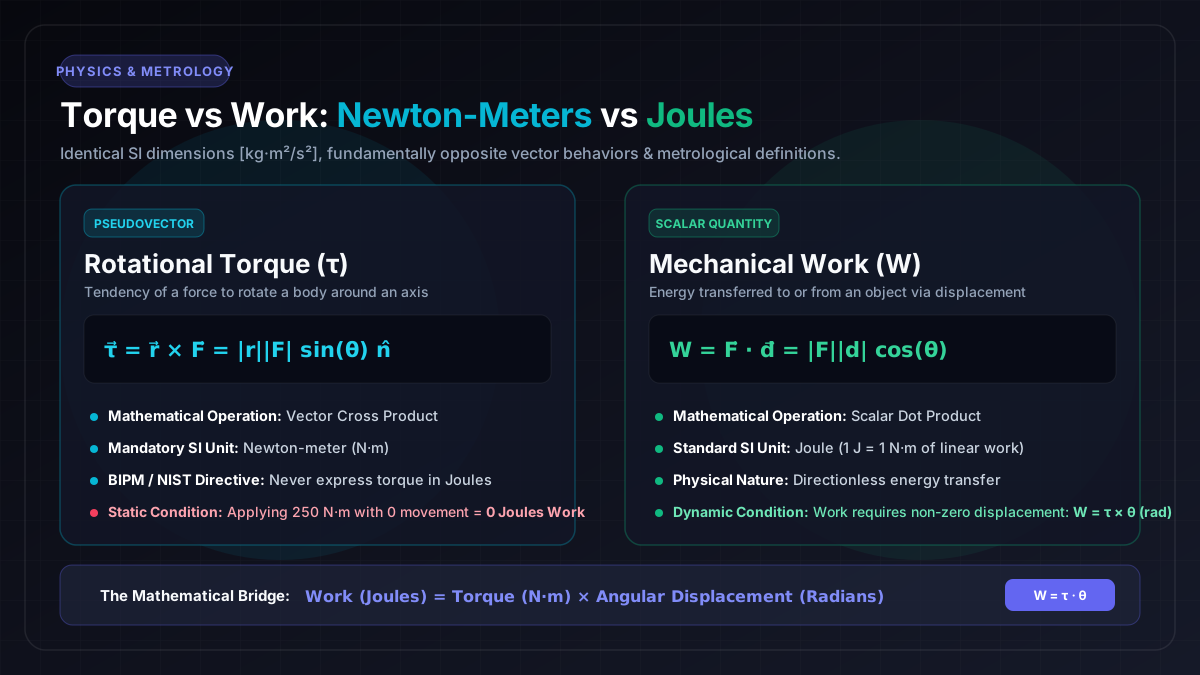
One of the most persistent and hazardous misconceptions in physics classrooms, machine shops, and automotive garages is treating the Newton-meter (N·m) and the Joule (J) as interchangeable units that can be converted back and forth without qualification:
1 N·m = 1 J (Only true for linear mechanical work!)While both units possess identical dimensional compositions in the International System of Units (SI)—specifically:
Dimensions: [M] × [L]² × [T]⁻² <=> kg·m²/s²They describe fundamentally different physical concepts.
If you walk into a precision aerospace calibration lab and ask for a “150 Joule torque wrench,” you will be immediately corrected. In this in-depth engineering analysis, we deconstruct the vector mathematics separating torque from work, examine international metrology regulations (BIPM and ISO 6789), analyze the “frozen bolt” zero-work paradox, and provide exact formulas to calculate rotational energy.
1. The Core Distinction: Pseudovectors vs Pure Scalars
The primary reason torque and work can never be treated as synonymous quantities lies in the vector mathematics that defines how each quantity is created in three-dimensional space.
Mechanical Work is formed by the scalar dot product of two vectors (W = F · d). It is a pure scalar with magnitude only.
Rotational Torque is formed by the vector cross product of two vectors (τ = r × F). It is a pseudovector possessing magnitude, a plane of application, and an axial direction governed by the Right-Hand Rule.
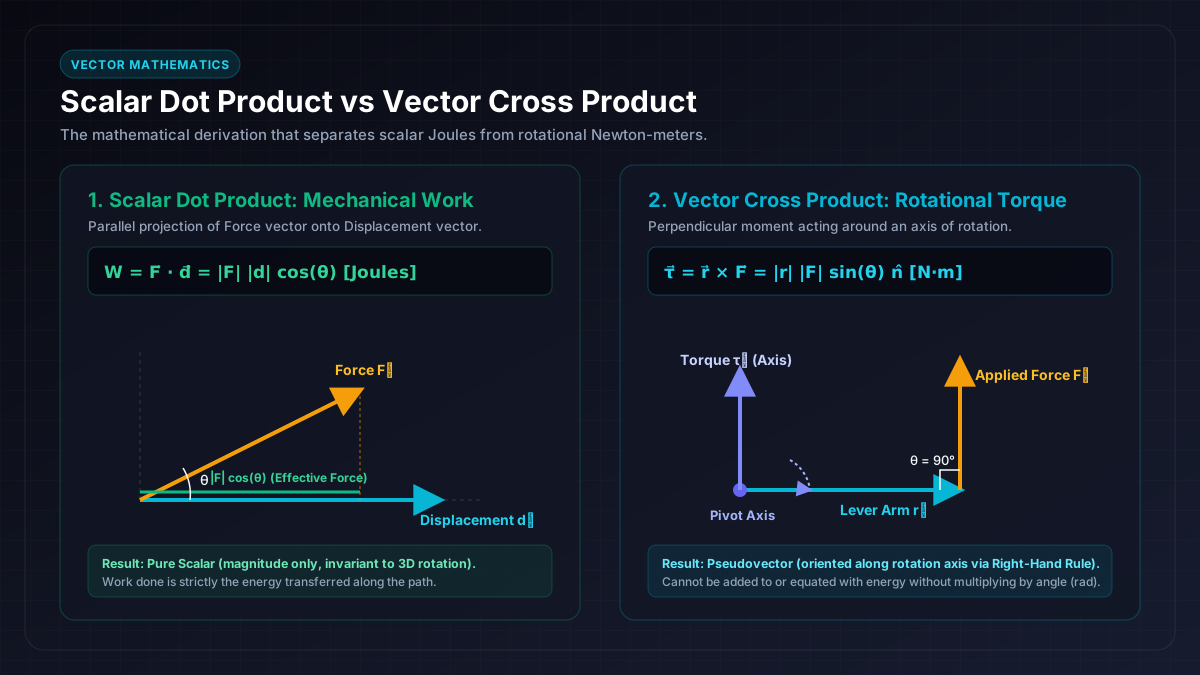
A. Mechanical Work: The Scalar Dot Product
Mechanical work represents energy transferred into or out of a physical system. When a force vector F displaces an object through displacement vector d, the work performed is given by the scalar dot product:
W = F · d = |F| × |d| × cos(θ)Where:
|F|is the magnitude of the applied force in Newtons (N).|d|is the linear displacement in meters (m).θis the angle between the force and displacement vectors.
Because the dot product evaluates the component of force acting collinear with displacement, the output W is a pure scalar. It has no directional orientation in space, cannot be pointed in a direction, and is completely invariant under coordinate system rotations. The standard SI unit for scalar mechanical work, kinetic energy, and thermal heat is the Joule (J).
B. Rotational Torque: The Vector Cross Product
Torque (τ), also known as the moment of force, measures the rotational tendency generated by a force applied at a distance from a pivot axis. It is defined as the vector cross product:
τ = r × F = |r| × |F| × sin(φ) n̂Where:
ris the position vector (moment arm) from the pivot to the point of force application (m).Fis the applied force vector (N).φis the angle between the position vector and the force vector.n̂is the unit normal vector perpendicular to both r and F, dictated by the Right-Hand Rule.
Because torque is the result of a cross product, it is a pseudovector (axial vector). Its vector arrow points along the axis of rotation—not in the direction of the applied force, nor along the arc of rotation, but straight through the pivot.
You cannot express an axial rotational moment in Joules, because a Joule contains zero directional information.
2. The “Frozen Bolt” Paradox: Static Torque vs Work
To grasp why torque does not automatically translate into Joules, consider a common automotive dilemma known in engineering mechanics as the “Frozen Bolt” Paradox:
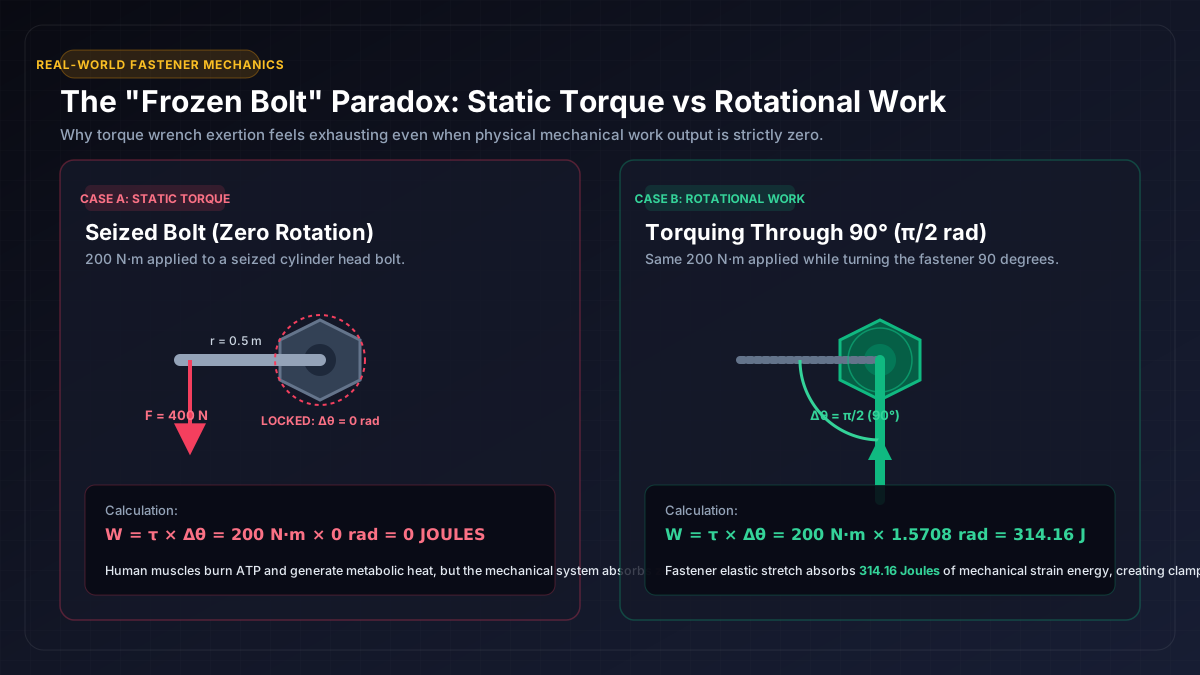
Imagine you are using a 0.5-meter breaker bar to loosen a severely rusted suspension bolt. You pull on the handle with a force of 400 N (approximately 90 lbs of force):
τ = r × F = 0.5 m × 400 N = 200 N·mYou hold this intense 200 N·m torque for 60 seconds. The bolt does not budge even a fraction of a millimeter. Your arms tremble, your heart rate accelerates, your muscles burn, and you break into a heavy sweat.
The Physics Verdict:
- Applied Torque: 200 N·m
- Angular Displacement (Δθ): 0 radians
- Mechanical Work on the Fastener:
W = τ × Δθ = 200 N·m × 0 rad = 0 Joules
Exactly zero Joules of mechanical energy were delivered to the bolt.
Why Did You Get Exhausted?
If zero mechanical work was done on the bolt, why did you expend so much physical effort?
The answer lies in human physiology rather than Newtonian mechanics:
- To maintain isometric tension in skeletal muscle, your muscle fibers continuously consume Adenosine Triphosphate (ATP).
- Microscopic actin and myosin cross-bridges repeatedly bind, pull, detach, and re-bind.
- This biochemical work within your muscle cells does not move the external object; instead, it is converted into metabolic thermal heat inside your body.
In mechanical terms, a static steel clamp or a concrete counterweight could apply that exact same 200 N·m torque indefinitely without consuming any energy whatsoever. Torque can exist statically forever with zero energy consumption.
3. How Torque Converts to Joules: The Role of the Radian
If static torque is not work, when does torque produce Joules of energy?
Torque transfers mechanical work only when it rotates through an angular displacement:
W = τ × θWhere:
- W is the mechanical work performed in Joules (J).
- τ is the applied torque in Newton-meters (N·m).
- θ is the angular displacement in radians (rad).
Why the Radian Is the Critical Mathematical Bridge
A common question arises: If torque is in N·m and angle is in radians, why is the unit of work not “Newton-meter radians” (N·m·rad)?
In the International System of Units, the radian is a dimensionless derived unit. It is defined as the ratio of circular arc length (s) to radius (r):
θ = s / r => [meters / meters] = 1 (dimensionless)Because the radian carries no physical dimensions:
Dimensions: (N·m) × (1) = N·m = Joules (J)Converting Revolutions and Degrees to Work
In practical machinery, rotation is rarely specified in radians; it is typically measured in degrees or revolutions:
- From Degrees:
θ (rad) = Degrees × (π / 180) W = τ × Degrees × (π / 180) - From Full Revolutions (N):
θ (rad) = N × 2π
W = τ × 2π × N
Example Calculation: Fastener Preload
Suppose you tighten a cylinder head bolt by applying a constant torque of 80 N·m through a rotation of 120 degrees:
- Convert degrees to radians:
θ = 120° × (π / 180) ≈ 2.0944 rad - Calculate total work performed:
W = 80 N·m × 2.0944 rad = 167.55 Joules
This 167.55 J of work is split between frictional heat generated in the threads and elastic potential energy stored in the stretched bolt shank, creating the critical clamping force that seals the engine gasket. Use our dedicated Bolt Torque Calculator to calculate required torque and fastener tension.
4. International Metrology Directives: BIPM, ISO, and NIST
The prohibition against using Joules for torque is not merely an academic preference; it is codified into international law and engineering standards.
BIPM SI Brochure (9th Edition, Section 2.3.4)
The Bureau International des Poids et Mesures (BIPM) states explicitly:
“An important example of a derived quantity is torque, which has the dimension of energy. Although it is dimensionally correct to use the unit Joule for torque, its use is strongly discouraged to avoid confusion between energy and torque. The unit Newton-meter is therefore preferred for torque.”
ISO 6789 Standard for Hand Torque Tools
Under ISO 6789-1:2017 (Assembly tools for screws and nuts — Hand torque tools), torque wrench manufacturers are legally required to calibrate and label tools exclusively in units of moment of force:
- Metric: N·m, cN·m
- Imperial: lbf·ft (foot-pounds), lbf·in (inch-pounds)
Marking a torque wrench in Joules violates ISO conformance and will fail aerospace quality audits (such as AS9100 and ISO 9001).
5. Foot-Pounds of Torque vs Foot-Pounds of Work
In the Imperial / US Customary system, a parallel confusion exists with the foot-pound:
| Quantity | Preferred Imperial Symbol | Mathematical Nature | Equivalent Metric Unit |
|---|---|---|---|
| Rotational Torque | lb-ft or lbf·ft (Pound-foot) | Pseudovector (Cross Product) | 1 lb-ft ≈ 1.355818 N·m |
| Mechanical Work / Energy | ft-lb or ft·lbf (Foot-pound) | Scalar (Dot Product) | 1 ft-lb ≈ 1.355818 Joules |
To minimize ambiguity, mechanical engineers use pound-feet (lb-ft) when referring to torque, and foot-pounds (ft-lb) when referring to work or energy.
Use our precision ft-lbs to Nm Converter and Nm to ft-lbs Converter to switch between Imperial and SI units accurately.
6. Torque vs Horsepower: The Rotational Power Equation
In automotive powertrains and electric motors, torque and rotational work are directly linked through rotational speed (RPM) to calculate Power:
Power (Watts) = dW / dt = τ × ωWhere ω is angular velocity in radians per second:
ω = (2π × RPM) / 60Substituting into the power equation gives:
P (kW) = (τ (N·m) × 2π × RPM) / 60,000 = (τ × RPM) / 9,548.8In Imperial units, this reduces to the famous automotive dynamometer formula:
Horsepower (HP) = (Torque (lb-ft) × RPM) / 5,252Because 1 HP = 33,000 ft·lb/min, dividing by 2π radians yields 33,000 / 2π ≈ 5,252.113. Therefore, on any Imperial dyno sheet, the torque (in lb-ft) and horsepower curves must intersect at exactly 5,252 RPM.
For a deeper dive into rotating powertrain mechanics, consult our comprehensive guide on How to Calculate Rotational Work From Torque and RPM and test your figures on our Torque to Power Calculator.
7. Comprehensive Conversion & Comparison Table
| Measurement Category | Unit Name | Symbol | Physical Quantity | Conversion Multiplier |
|---|---|---|---|---|
| Torque Units (Moments) | Newton-meter | N·m | SI Base Torque | 1.0 N·m (Standard) |
| Pound-foot | lbf·ft (ft-lbs) | Imperial Torque | = 1.355818 N·m | |
| Pound-inch | lbf·in (in-lbs) | Precision Fasteners | = 0.112985 N·m | |
| Kilogram-force meter | kgf·m | Metric Gravitational | = 9.80665 N·m | |
| Work & Energy Units | Joule | J | SI Base Work/Energy | = 1 N·m of linear work |
| Kilowatt-hour | kWh | Electrical / EV Energy | = 3,600,000 Joules | |
| Foot-pound force | ft·lbf | Imperial Work | = 1.355818 Joules | |
| Calorie (thermochemical) | cal | Thermal Energy | = 4.184 Joules | |
| British Thermal Unit | BTU | HVAC / Heat | = 1,055.06 Joules |
8. Frequently Asked Questions (FAQ)
Why does my torque wrench click if no work is done?
A mechanical click-type torque wrench uses an internal calibrated spring and ball-and-ramp detent mechanism. When the torque applied to the fastener reaches the preset preload on the internal spring, the mechanism breaks over and releases against the tool wall, creating the audible “click” and haptic impulse. It measures rotational resistance moment, regardless of whether the bolt actually rotated.
Can torque be negative?
Yes. Because torque is a vector quantity, its sign indicates the direction of rotation. By standard convention:
- Counter-clockwise rotation is treated as positive torque (+τ).
- Clockwise rotation is treated as negative torque (-τ). In work calculations, if torque acts in the opposite direction of rotation (such as during engine braking or regenerative decelerations), the work performed is negative (W < 0), removing kinetic energy from the vehicle.
What is the difference between N·m and Joules on an EV motor spec sheet?
On an electric vehicle specification sheet:
- Max Torque (e.g., 450 N·m): Indicates the instantaneous twisting force delivered by the rotor from 0 RPM, directly determining off-the-line acceleration.
- Battery Capacity (e.g., 75 kWh = 270 MJ): Expressed in kilowatt-hours or mega-Joules, indicating the total reservoir of electrical potential energy available to perform work.
How much work is done tightening an M10 bolt 90 degrees at 60 N·m?
Convert 90 degrees to radians:
θ = 90° × (π / 180) = π / 2 ≈ 1.5708 rad
Multiply by torque:
W = 60 N·m × 1.5708 rad = 94.25 Joules
The mechanic performs 94.25 Joules of work, stretching the bolt to create clamping load.
Engineering Takeaway & Practical Tools
The rule of thumb for every practicing technician and engineer is simple:
- Use Newton-meters (N·m) when specifying fasteners, shaft twisting moments, or structural bending.
- Use Joules (J) when calculating energy transfer, heat dissipation, or work done through a distance or angle.
- Convert between them by multiplying torque by angular displacement in radians:
W = τ · θ.
To calculate torque, preload, power, and energy conversions accurately, use our dedicated engineering calculators: