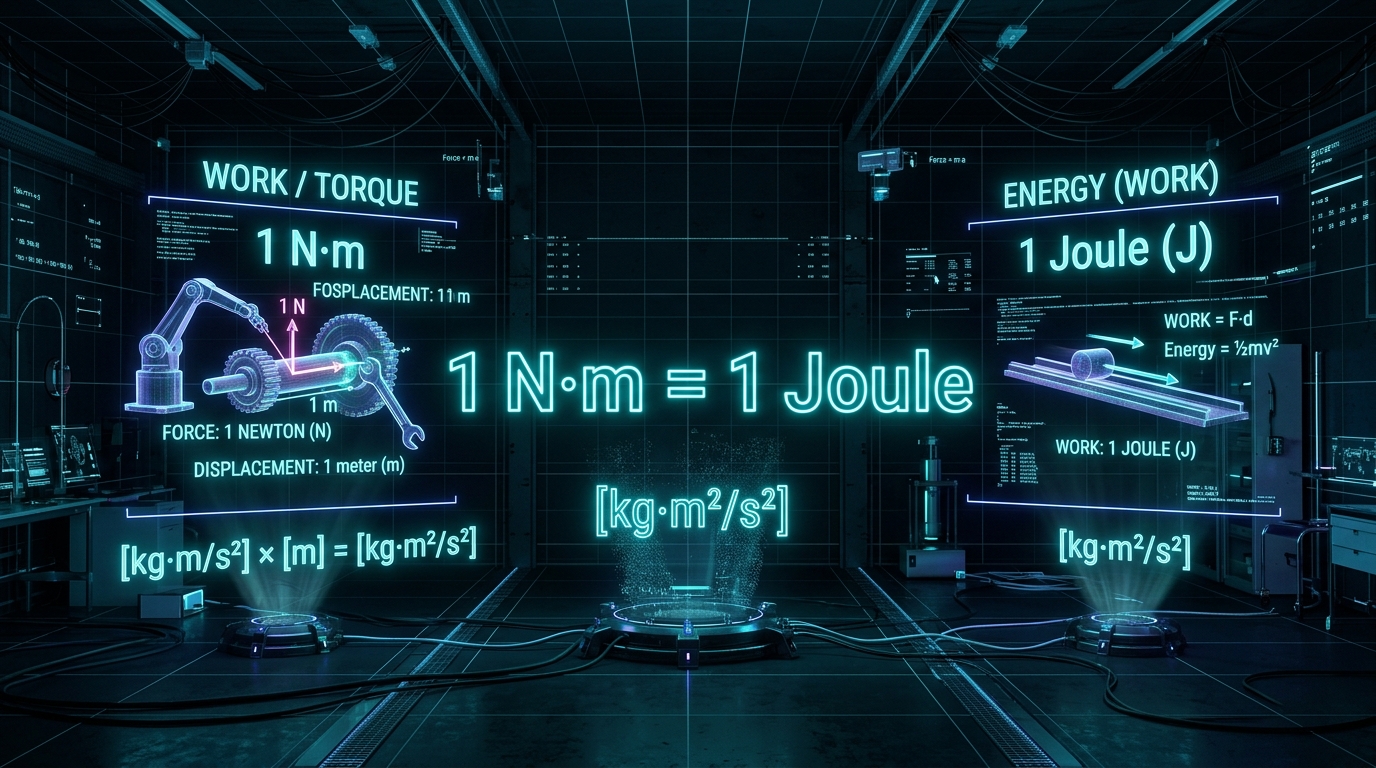
At first encounter in introductory physics or mechanical engineering, the equivalence between 1 Newton-meter (N·m) and 1 Joule (J) often strikes students and practicing engineers as an intriguing paradox:
1 N·m = 1 JHow can a unit commonly associated with the mechanical twisting force on a lug nut (Newton-meters) be mathematically and dimensionally identical to the unit measuring thermodynamic heat, electrical energy, or kinetic energy (Joules)?
Why is there no fractional conversion constant, no empirical scalar, and no conversion loss between them?
In this comprehensive metrology guide, we demonstrate the dimensional derivation from first principles using the International System of Units (SI) base definitions, illustrate linear work mechanics, demystify why energy and torque share dimensions, and clarify the crucial engineering boundaries where equating them leads to catastrophic calculation errors.
1. The SI Base Dimensions of Classical Mechanics
Every derived mechanical unit in modern physics is composed of combinations of fundamental physical dimensions. According to the Bureau International des Poids et Mesures (BIPM), the mechanical branch of the SI system rests upon three irreducible base quantities:
| Physical Quantity | Dimension Symbol | SI Base Unit | Standard Symbol |
|---|---|---|---|
| Mass | [M] | kilogram | kg |
| Length | [L] | meter | m |
| Time | [T] | second | s |
All other mechanical quantities—such as velocity, acceleration, momentum, force, pressure, torque, and work—are derived by multiplying or dividing these three base units.
2. Deriving the Newton: The SI Unit of Force
To understand why the Newton-meter equals the Joule, we must first deconstruct the Newton (N) into its base constituents.
According to Newton’s Second Law of Motion, the net force F acting on a body is directly proportional to the product of its mass m and the acceleration a imparted to it:
F = m × aLet us break down each term into SI base units:
- Mass (m): Measured in kilograms (kg).
- Velocity (v): Displacement per unit time:
Velocity = Δx / Δt [m/s] - Acceleration (a): Rate of change of velocity per unit time:
Acceleration = Δv / Δt = (m/s) / s = m/s²
Now substitute mass and acceleration into the force equation:
Force (N) = Mass (kg) × Acceleration (m/s²)
1 N = 1 kg·m·s⁻² = 1 kg·m/s²
One Newton is officially defined as the magnitude of force required to accelerate a mass of exactly one kilogram at a rate of one meter per second squared.
3. Deriving the Newton-Meter: Force Exerted Over Distance
When an external force acts along a displacement vector, we calculate the product of force and distance:
Force-Distance = Force (N) × Distance (m)Substituting our derived base units for the Newton:
Unit of N·m = (kg·m/s²) × (m) = kg·m²/s²Multiplying the meters together yields:
1 N·m = 1 kg·m²·s⁻² = 1 kg·m²/s²The dimensional signature of a Newton-meter is therefore:
[N·m] = [M] × [L]² × [T]⁻²4. Deriving the Joule: The SI Unit of Energy and Work
Now let us examine the Joule (J), named in honor of the English physicist James Prescott Joule for his foundational work on the mechanical equivalent of heat.
A. Derivation from Mechanical Work
In classical physics, mechanical work (W) is performed when a force causes an object to move through a displacement d parallel to the force:
W = F × dIf a constant force of 1 Newton acts over a collinear displacement of 1 meter, the work performed is defined as exactly 1 Joule:
1 J = 1 N × 1 m = (1 kg·m/s²) × (1 m) = 1 kg·m²/s²B. Derivation from Kinetic Energy
To verify that this dimensional relationship is universal across all forms of energy, consider the equation for translational kinetic energy (Ek):
E_k = ½ × m × v²Substituting the SI base units:
- Mass (m): kg
- Velocity (v): m/s
- Squared Velocity (v²): m²/s²
- The dimensionless coefficient ½ carries no units.
[E_k] = (kg) × (m/s)² = kg·m²/s² = JouleC. Derivation from Gravitational Potential Energy
Similarly, evaluate gravitational potential energy (Ep):
E_p = m × g × hWhere:
- m = mass (kg)
- g = gravitational acceleration (m/s²)
- h = height displacement (m)
[E_p] = (kg) × (m/s²) × (m) = kg·m²/s² = Joule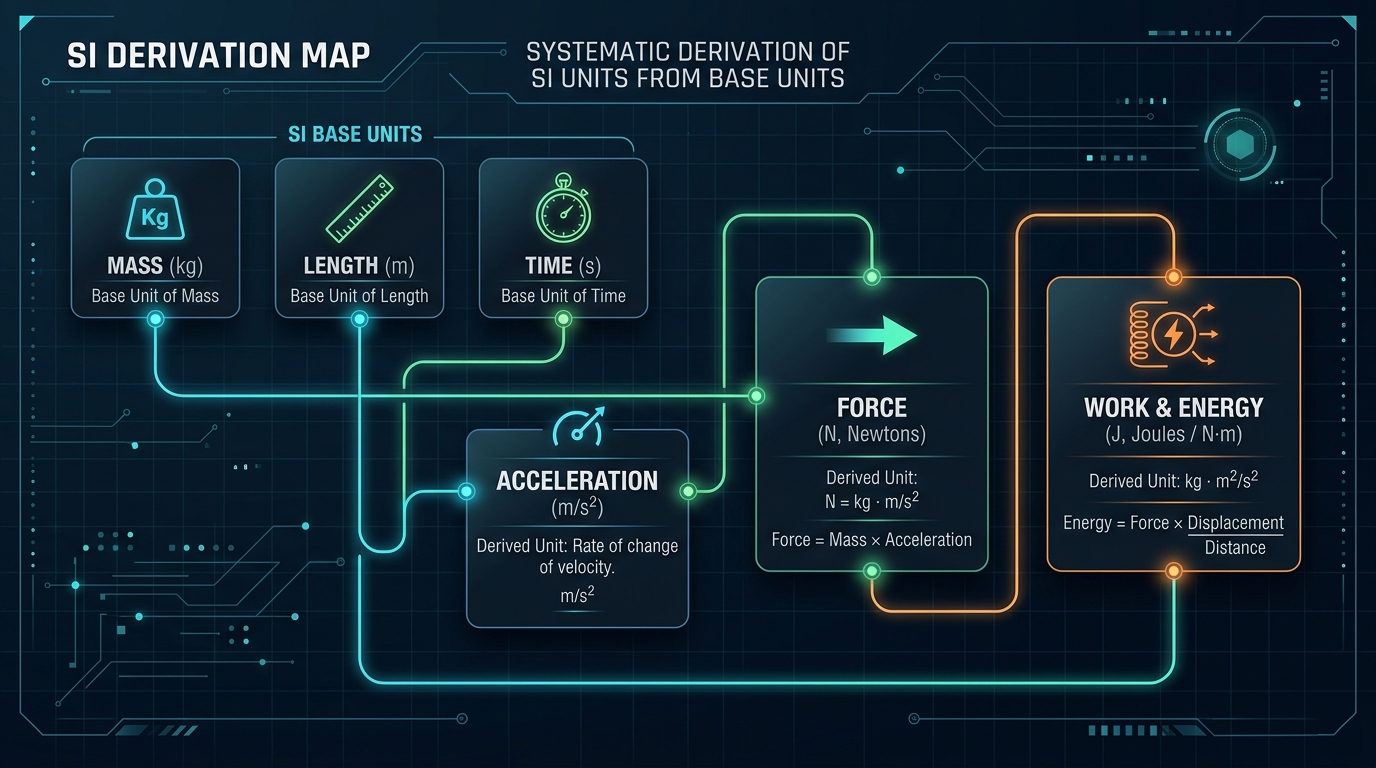
Because both expressions collapse into the identical dimensional identity:
[M]¹ [L]² [T]⁻² <=> kg·m²/s²1 Newton-meter and 1 Joule are dimensionally identical. In the context of linear mechanical work, 1 N·m transferred equals exactly 1 Joule of energy absorbed.
5. Visualizing Linear Work: 1 Newton Over 1 Meter
To cement this relationship physically, imagine an experiment conducted on an idealized frictionless linear track:
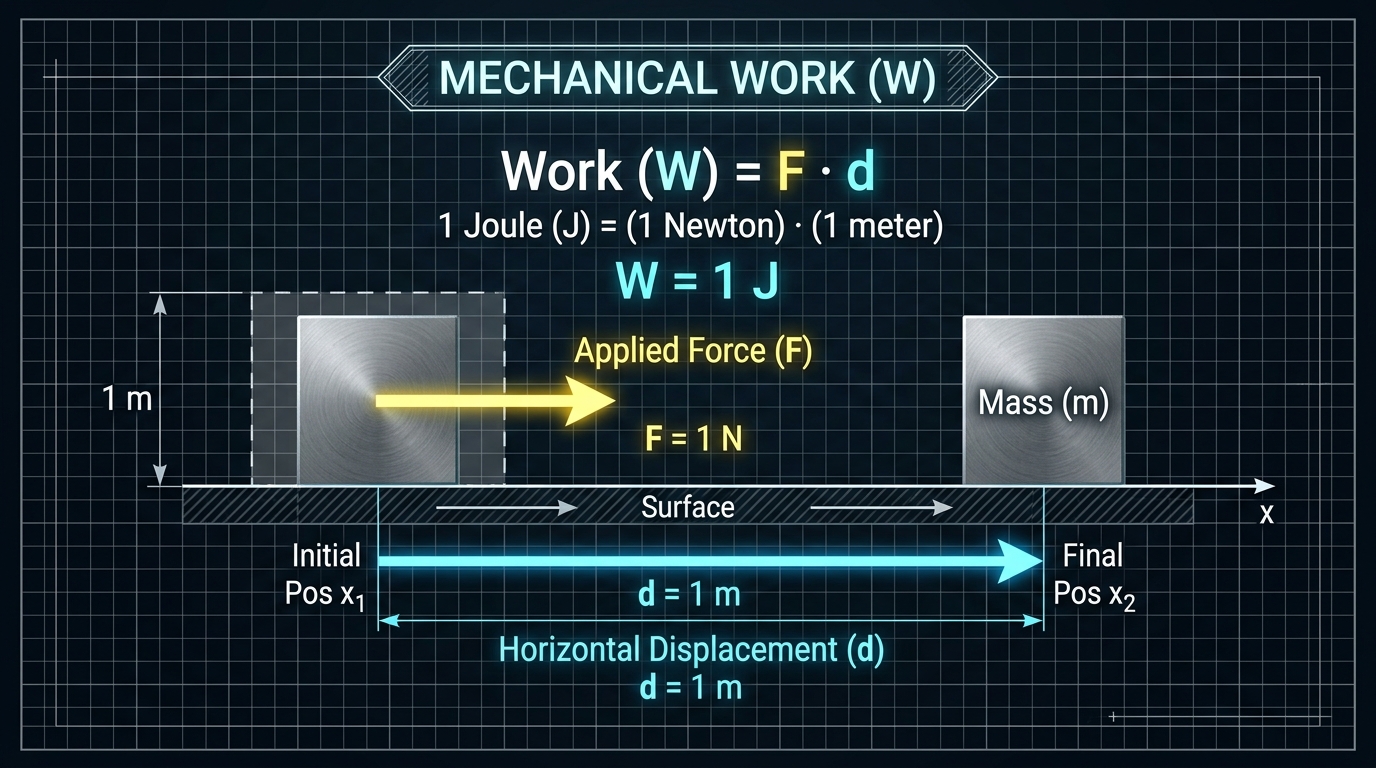
- A mass of 1 kg is accelerated at 1 m/s². The force exerted on the block is
F = 1 N. - The force continues to push the block in a straight line for a distance of
d = 1 m. - The total work performed on the block is:
W = F × d = (1 N) × (1 m) = 1 N·m = 1 J - At the end of that 1-meter run, the object has gained exactly 1 Joule of kinetic energy. If you convert that energy to thermal heat via friction, it will heat the track by exactly 1 Joule (0.239 calories).
You can use our free Nm to Joules Converter to instantly convert any linear mechanical work value or explore the reverse transformation on our Joules to Nm Calculator.
6. When 1 N·m = 1 J vs When They Must Diverge
Although their dimensions match, you cannot blindly substitute Joules for Newton-meters in every mechanical scenario.
In physics and engineering metrology, units communicate both dimensional quantity and physical context:
Energy is a scalar quantity (directionless magnitude). Static torque is a vector moment / pseudovector (rotational tendency about a specific axis). While work done by torque through an angle produces Joules, static torque itself is never expressed in Joules.
Let us examine the exact boundaries:
Scenario A: Linear Work and Energy Storage (1 N·m = 1 J)
When force causes linear displacement in the direction of the force vector, the relationship is a true 1:1 identity:
- Compressing a spring with an average force of 50 N across 0.2 m:
W = 50 N × 0.2 m = 10 N·m = 10 Joules of potential energy stored. - Lifting a 10.197 kg weight by 1 meter against Earth gravity (
g = 9.80665 m/s²):W = (10.197 kg × 9.80665 m/s²) × 1 m = 100 N·m = 100 Joules.
Scenario B: Static Torque (1 N·m != 1 J)
When tightening an automotive cylinder head bolt with a calibrated torque wrench set to 120 N·m, the bolt does not undergo linear displacement.
If the bolt reaches its target torque and stops turning:
- The torque applied is 120 N·m.
- The angular displacement is
Δθ = 0 rad. - The mechanical work performed on the bolt is:
W = τ × Δθ = 120 N·m × 0 = 0 Joules
Even though you exerted considerable muscle force holding the wrench handle, zero Joules of energy were transferred to the fastener. Expressing that torque wrench rating as “120 Joules” would be physically incorrect and dangerously misleading. For an in-depth dive into fastener mechanics, explore our dedicated guide on Torque vs Work: Why 1 N·m Is Not Always 1 Joule and our Bolt Torque Calculator.
Scenario C: Rotational Work (W = τ × θ)
When torque τ causes a shaft or fastener to rotate through an angular displacement θ measured in radians, rotational work is performed:
W = τ × θBecause the radian is a dimensionless ratio of arc length to radius (m / m = 1):
Units: (N·m) × (rad) = N·m = Joules (J)If a motor applies 50 N·m of torque over 10 full revolutions (10 × 2π ≈ 62.83 rad):
W = 50 N·m × 62.8318 rad = 3,141.59 Joules
To calculate rotational energy and power outputs effortlessly, check our specialized Rotational Work Calculator and Torque to Power Calculator.
7. Critical Warning: Newton-Meters (N·m) vs Nanometers (nm)
A very common source of confusion in physics and web searches arises from capitalization and typographic errors:
- N·m (Capital N, dot, lower m): Newton-meter, the mechanical unit of torque and work (
1 N·m = 1 Jof work). - nm (All lowercase): Nanometer, a unit of length equal to one-billionth of a meter (
1 nm = 10⁻⁹ m).
In optical physics and quantum mechanics, converting light wavelength in nanometers (nm) to photon energy in Joules (J) follows the Planck-Einstein relation:
E = (h × c) / λWhere:
- h = Planck’s constant (
6.62607015 × 10⁻³⁴ J·s) - c = Speed of light in vacuum (
2.99792458 × 10⁸ m/s) - λ = Wavelength in meters (
nm × 10⁻⁹)
For instance, green laser light with a wavelength of 532 nm carries photon energy:
E = (6.626 × 10⁻³⁴ × 3 × 10⁸) / (532 × 10⁻⁹) ≈ 3.73 × 10⁻¹⁹ JoulesIf you need to perform quantum or optical wavelength conversions, use our dedicated Wavelength nm to Joules Calculator.
8. Real-World Engineering Scenarios
To see how the dimensional equivalence 1 N·m = 1 J functions in industrial systems, consider these three case studies:
Case 1: Industrial Crane Hoist Mechanism
An overhead gantry crane in a logistics warehouse lifts a 500 kg steel crate vertically by 4 meters:
- Force required against gravity:
F = m × g = 500 kg × 9.81 m/s² = 4,905 N - Work performed along the vertical displacement:
W = F × h = 4,905 N × 4 m = 19,620 N·m - Total potential energy stored in the lifted payload:
E_p = 19,620 Joules = 19.62 kJHere, the mechanical product of force and distance translates directly into stored Joules without any conversion scalar.
Case 2: Automotive Disc Brake Thermal Dissipation
When a 1,600 kg passenger vehicle slows from 100 km/h (27.78 m/s) to a full stop:
- Initial vehicle kinetic energy:
E_k = ½ × m × v² = 0.5 × 1,600 kg × (27.78 m/s)² ≈ 617,358 Joules - Friction force over braking distance:
If the vehicle stops in 40 meters, the average net braking force exerted by tires and calipers is:
F = W / d = 617,358 J / 40 m = 15,434 N - The brake rotors absorb
15,434 N × 40 m = 617,358 N·m = 617.4 kJof thermal energy, converting mechanical motion into heat.
Case 3: Flywheel Kinetic Energy Storage
Industrial uninterruptible power supply (UPS) systems use rotating flywheels to store rotational energy:
- Moment of inertia:
I = 2.5 kg·m² - Angular velocity:
ω = 1,000 rad/s (≈ 9,549 RPM) - Rotational kinetic energy:
E_r = ½ × I × ω² = 0.5 × 2.5 kg·m² × (1,000 rad/s)² = 1,250,000 Joules = 1.25 MJ
9. Comprehensive Comparison Matrix
The table below summarizes the key physical quantities that share the dimensional representation [M] [L]² [T]⁻²:
| Physical Quantity | Mathematical Formula | Vector Type | Standard SI Unit | Interchangeable with Joules? |
|---|---|---|---|---|
| Linear Work | W = F · d | Scalar | Joule (J) or N·m | Yes (1:1 Exact) |
| Kinetic Energy | E_k = ½mv² | Scalar | Joule (J) | Yes (1:1 Exact) |
| Potential Energy | E_p = mgh | Scalar | Joule (J) | Yes (1:1 Exact) |
| Rotational Work | W = τ · θ | Scalar | Joule (J) | Yes (1:1 with rad) |
| Rotational Torque | τ = r × F | Pseudovector | Newton-meter (N·m) | No (Forbidden by BIPM) |
| Bending Moment | M = F · L | Pseudovector | Newton-meter (N·m) | No (Structural Load) |
| Thermal Heat | Q = mcΔT | Scalar | Joule (J) | Yes (1:1 Exact) |
10. Frequently Asked Questions (FAQ)
Can I write torque in Joules if the numbers are the same?
No. The BIPM SI brochure (Section 2.3.4) explicitly forbids using the Joule to express torque. Torque is a directional rotational tendency (pseudovector), whereas the Joule is exclusively reserved for scalar quantities of energy, work, and heat. Using Joules for torque causes confusion between energy capacity and structural fastener limits.
Why do torque and work have the exact same SI base units?
Both quantities are calculated by multiplying a force by a distance. However, in work, the force and displacement vectors are collinear (scalar dot product: F · d), resulting in energy transfer. In torque, the force and radius vectors are perpendicular (vector cross product: r × F), creating a moment about an axis without necessarily producing displacement.
What is 1 Newton-meter in Imperial units?
1 N·m of torque is equal to approximately:
- 0.737562 ft-lbs (foot-pounds)
- 8.85075 in-lbs (inch-pounds)
- 10.197 kgf·cm (kilogram-force centimeters)
Convert between metric and imperial torque units instantly with our precision ft-lbs to Nm Converter and Nm to ft-lbs Converter.
How do I convert rotational torque into Joules?
To convert rotating torque into Joules of mechanical work, you must multiply the torque (in N·m) by the total angular rotation θ measured in radians:
W (Joules) = Torque (N·m) × Angle (radians)
Since 1 revolution = 2π radians ≈ 6.283185 rad, multiplying torque by revolutions and 2π yields the energy transferred in Joules.
Does pushing against an immovable wall perform work in Joules?
No. Even if you exert a force of 500 N for 10 minutes until you collapse from exhaustion, the wall’s displacement is d = 0 m. Therefore:
W = F × d = 500 N × 0 m = 0 Joules
Your body expends metabolic energy and generates biological heat through microscopic muscle contractions (ATP hydrolysis), but zero mechanical work is performed on the wall.
Conclusion & Next Steps
The mathematical reality that 1 N·m = 1 J is a cornerstone of the International System of Units. In linear mechanics, every Newton of force sustained across one meter transfers exactly one Joule of kinetic, potential, or thermal energy.
When dealing with rotating machinery or threaded fasteners, remember to account for the angular displacement in radians before converting to Joules.
Explore our comprehensive suite of engineering calculators to streamline your workflow: